
If you’re searching for Kashmiri saffron wholesale, looking to buy Kashmiri saffron bulk for your restaurant chain, luxury brand, or distribution network, or seeking a reliable Kashmiri saffron exporter from India who can provide authentic, lab-tested, export-grade product with full documentation this comprehensive guide is written specifically for you.
At Darnif Exim, we’ve built our reputation over decades by working directly with farmers in GI-certified regions for Makhana exports, establishing transparent, farmer-first relationships that eliminate intermediary markups while ensuring premium quality. Using this same proven model, we’ve expanded into GI certified Kashmiri saffron authentic, lab-testable, export-grade saffron sourced directly from Kashmir’s traditional cultivation zones.
Whether you’re a wholesale saffron buyer for hotels, an importer serving European gourmet markets, a private label Kashmiri saffron supplier India building premium retail brands, or a food manufacturer requiring consistent pharmaceutical-grade inputs, Darnif Exim provides the quality, documentation, and reliability that serious international buyers demand.
Table of Contents
Why Kashmiri Saffron Commands Global Premium Pricing
The Quality Distinction: Kashmir Saffron vs. Iran Saffron
Globally, approximately 90% of saffron in commercial circulation originates from Iran. While Iranian production dominates global volume, Kashmiri saffron dominates quality metrics that matter to discerning buyers.
Here’s what we’ve learned directly from Kashmir growers through decades of agricultural expertise:
| Quality Parameter | Kashmiri Saffron | Iranian Saffron |
| Thread Thickness | Thick, fleshy stigmas (premium visual appeal) | Thin, delicate threads |
| Aroma Profile | Deep, complex, long-lasting fragrance | Sharp initial aroma, dissipates quickly |
| Coloring Strength | Slow-release natural color, golden-yellow hue | Fast color release, sometimes artificially enhanced |
| Processing Method | Traditional sun-drying, minimal intervention | Often polished, machine-processed for uniformity |
| Adulteration Risk | Very low (GI protection, small-scale farming) | Higher risk in commodity-grade bulk markets |
| Crocin Content | Naturally high (250-280+ per ISO 3632) | Variable (150-250 depending on grade) |
For buyers in UK, EU, Dubai, and USA markets, the purchasing decision isn’t simply about acquiring “red threads” it’s about securing quality attributes: profound aroma that transforms culinary applications, natural coloring strength that meets food manufacturer specifications, purity that satisfies pharmaceutical standards, and authentic origin that premium brands can confidently communicate to consumers.
What Drives Kashmiri Saffron’s Superior Quality?
1. Geographic and Climatic Advantage
Kashmir’s saffron-growing regions primarily Pampore, Kishtwar, and surrounding districts provide ideal cultivation conditions:
- Altitude: 1,500-1,800 meters above sea level creates temperature variations that intensify flavor compounds
- Soil Composition: Karewa soil formation (loess-type alluvial deposits) provides optimal drainage and mineral content
- Climate: Cold winters followed by temperate spring growth periods allow slow stigma development, concentrating aromatic compounds
- Water Quality: Snowmelt irrigation provides mineral-rich, pure water without chemical contamination
2. Traditional Cultivation Practices
Unlike industrial Iranian production, Kashmiri saffron cultivation remains a small-scale, labor-intensive craft:
- Hand Harvesting: Each Crocus sativus flower picked manually at dawn before sunlight degrades compounds
- Immediate Processing: Stigma separation occurs within hours of harvest to preserve volatile oils
- Sun Drying: Natural dehydration in controlled shade (temperature rarely exceeds 34-36°C) preserves aromatic integrity
- No Chemical Enhancement: Traditional methods prohibit artificial coloring, polishing, or preservative treatments
3. Limited Production Creates Scarcity Premium
Kashmir produces only 6-8 tonnes annually compared to Iran’s 200+ tonnes. This scarcity, combined with superior quality, creates the price differential that serious buyers understand represents genuine value, not arbitrary markup.
GI Certified Kashmiri Saffron: Legal Protection for Authentic Origin
What GI Certification Actually Guarantees
The Geographical Indication (GI) tag for Kashmiri saffron isn’t merely a marketing label it’s a legal certification that guarantees:
1. Verified Geographic Origin
- Cultivation exclusively in designated Kashmir regions (Pampore, Kishtwar, specific districts)
- Traceable farm sources with documented cultivation records
- Protection against mislabeling non-Kashmiri saffron as “Kashmiri”
2. Traditional Production Methods
- Adherence to historical cultivation and processing techniques
- No industrial processing or chemical enhancement
- Hand-harvesting and natural sun-drying requirements
3. Quality Benchmark Standards
- Minimum crocin content (coloring strength indicator)
- Minimum safranal content (aroma compound)
- Minimum picrocrocin content (bitter taste component, quality indicator)
- Moisture content specifications for shelf stability
Why GI Matters for Serious Buyers?
For wholesale saffron for hotels, luxury brands, pharmaceutical companies, and export distributors, GI certification functions as quality insurance:
- Brand Protection: Communicate authentic origin with legal backing to end consumers
- Regulatory Compliance: Meets EU, UK, and international food authenticity regulations
- Price Justification: GI certification provides objective basis for premium pricing
- Supply Chain Transparency: Traceable origin satisfies corporate sustainability requirements
- Reduced Adulteration Risk: Legal framework and tight geographic control minimize counterfeit exposure
Understanding Kashmiri Saffron Commercial Grades
Kashmiri saffron for export falls into three primary commercial categories, each serving distinct buyer segments:
1. Kishtwari Saffron (Ultra-Premium Export Grade)
Origin & Production:
- Grown exclusively in Kishtwar district at high altitudes
- Extremely limited annual production: approximately 50-60 kg total across all Kishtwar farms
- Long growing season in harsh climate intensifies aromatic compounds
Physical Characteristics:
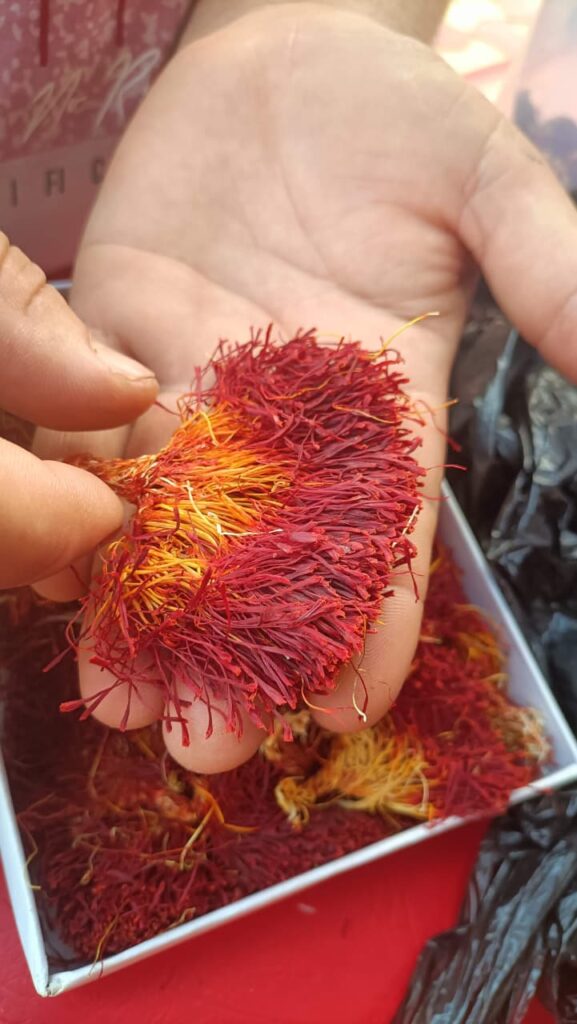
- Thread Length: Exceptionally long stigmas (almost half-finger length)
- Thickness: Notably thick, fleshy texture compared to standard grades
- Color: Deep crimson with slight orange tips
- Aroma: Profoundly complex fragrance described as “honeyed” with floral undertones
Quality Metrics:
- Coloring Strength: 10 – 20x more potent than commodity saffron
- Crocin Content: Often exceeds 280 (ISO 3632 standard)
- Safranal: Highest natural concentration among all saffron varieties
Target Buyer Segments:
- Michelin-starred restaurants requiring exceptional culinary performance
- Luxury retail brands (premium packaging, high-end gifting)
- Pharmaceutical & nutraceutical manufacturers needing maximum active compound concentration
- High-end hospitality (5-star hotels, luxury resorts)
Typical Pricing Range: Premium tier (contact for current rates as limited availability creates price volatility)
2. Kashmiri Mogra Saffron (Premium Bulk Grade)
Origin & Production:
- Cultivated primarily in Pampore (saffron capital of Kashmir)
- Larger production volume than Kishtwari (still limited vs. global supply)
- Represents the classic “Kashmiri saffron” most international buyers reference
Physical Characteristics:
- Thread Quality: Thick, full stigmas with minimal style (yellow portion) attachment
- Color Uniformity: Consistent deep red throughout
- Aroma: Strong, characteristic Kashmiri fragrance
- Moisture: Properly dried to 8-12% for optimal shelf life
Quality Metrics:
- Crocin Content: 220-260 (ISO 3632)
- Coloring Strength: Excellent for culinary and commercial applications
- Authenticity: GI-certified origin with full traceability
Target Buyer Segments:
- Hotels & restaurant chains requiring consistent quality at reasonable volume
- Wholesale resale distributors serving gourmet retailers
- Private label saffron brands for packaged retail products
- Food manufacturers (ice cream, confectionery, ready-meals requiring saffron)
Ideal for: Buyers seeking best saffron for restaurants bulk orders with proven quality and competitive wholesale pricing
3. Iranian Grades (Super Negin / Sargol) – On Demand
Why We Offer Iranian Saffron:
We recognize that some buyers require price-competitive alternatives for specific applications where Kashmiri premium isn’t essential:
- Super Negin saffron bulk supplier: Highest Iranian grade (all-red stigmas, minimal style)
- Sargol saffron wholesale: Premium Iranian grade suitable for most commercial applications
Critical Transparency:
- Clearly labeled as non-Kashmiri origin on all documentation
- No misrepresentation as Kashmiri product
- Competitive pricing for budget-conscious applications
- Same documentation standards: COA, phytosanitary, quality certifications
Typical Applications:
- Large-scale food manufacturing where cost management is critical
- Markets where consumers prioritize price over premium origin
- Bulk ingredients for processed foods
How Kashmiri Saffron Is Actually Produced: Farm to Export?
Understanding the production process helps buyers appreciate quality differences and pricing structures.
The Annual Cultivation Cycle
September-October: Harvest Season
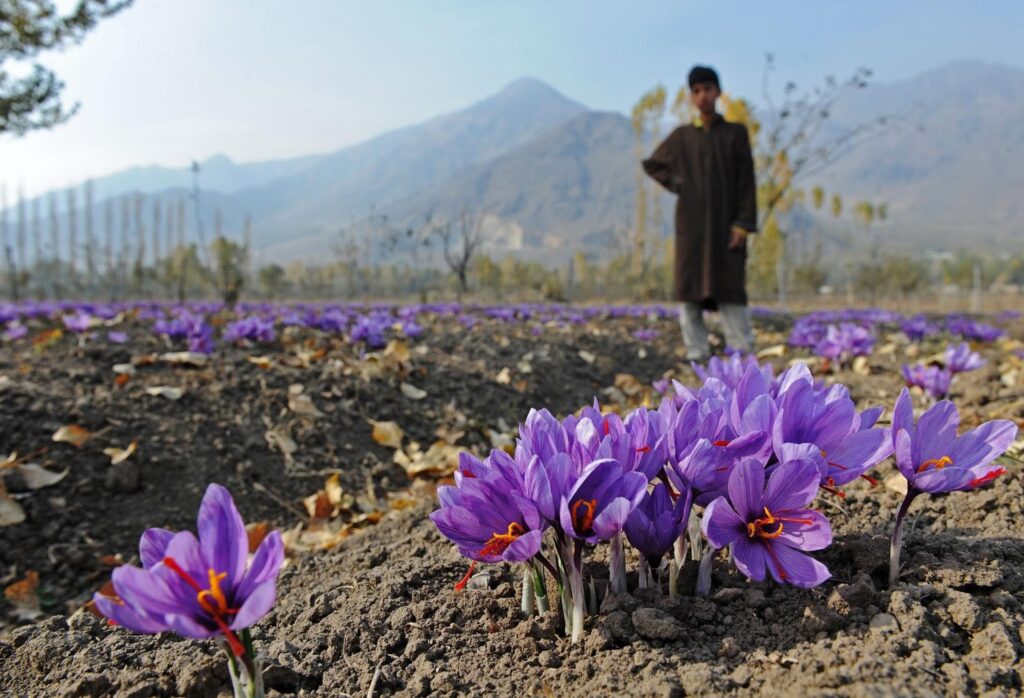
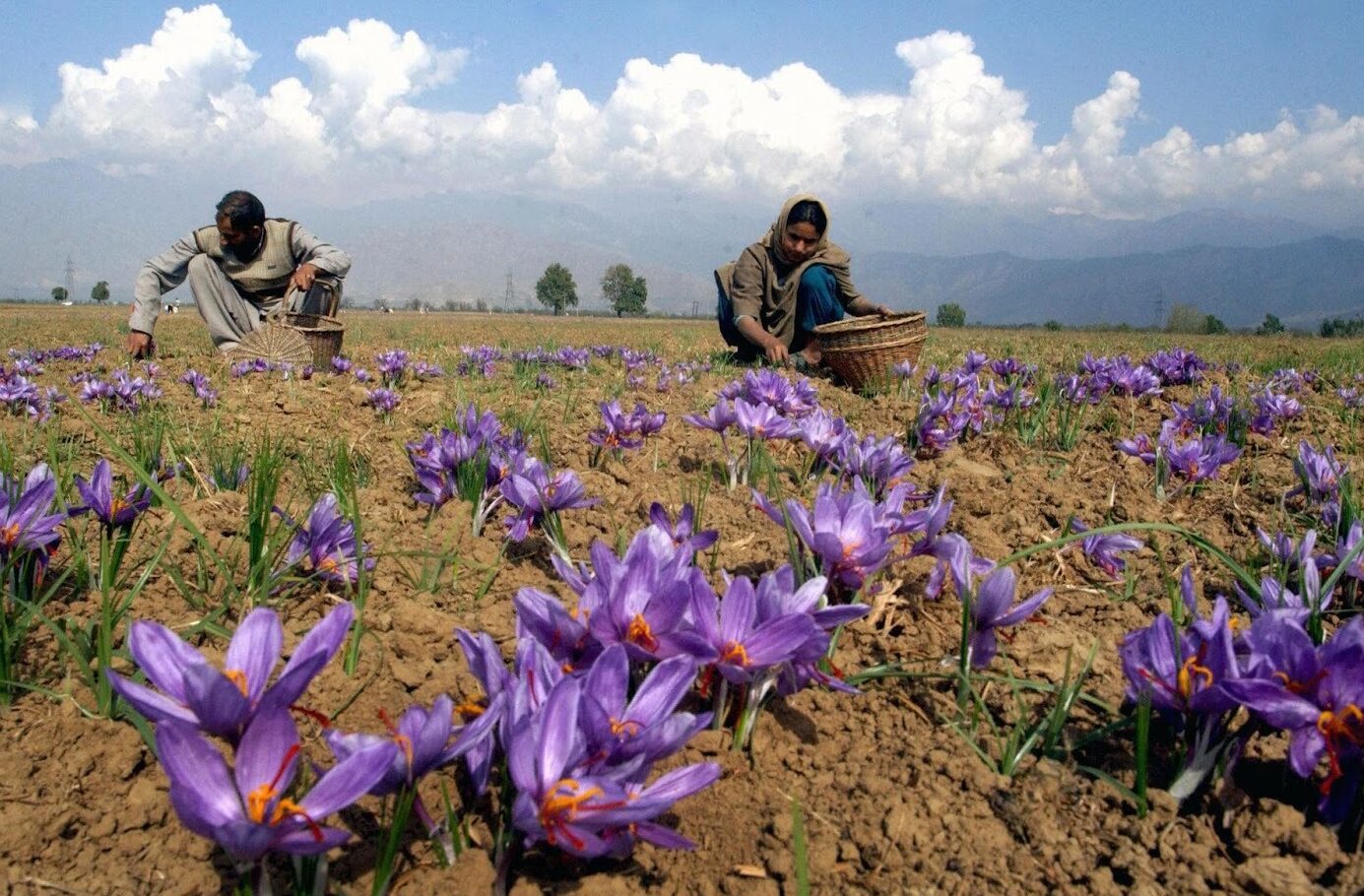
- Flower Emergence: Purple Crocus sativus flowers bloom over 2-3 week period
- Dawn Harvesting: Farmers collect flowers in early morning before sunlight exposure
- Critical Timing: Flowers must be processed within 2-4 hours of picking to preserve volatile oils
Stigma Separation (Most Labor-Intensive Phase)
- Manual Extraction: Each flower contains only 3 red stigmas
- Skilled Labor: Experienced workers carefully separate stigmas from styles and petals
- Quality Sorting: Damaged or inferior stigmas removed during this stage
- Volume Reality: Approximately 150,000-200,000 flowers required for 1 kg dried saffron
Natural Sun-Drying Process
- Traditional Method: Stigmas spread on fine mesh screens in shaded, well-ventilated areas
- Temperature Control: Drying temperature strictly maintained at 34-36°C maximum
- Duration: 8-12 hours depending on ambient humidity
- Moisture Target: Final product reaches 8-12% moisture content for optimal shelf stability
- No Mechanical Processing: Unlike Iranian industrial methods, Kashmiri saffron avoids ovens, polishing, or artificial enhancement
Post-Harvest Storage & Aging
- Immediate Protection: Dried saffron stored in airtight containers away from light and moisture
- Aging Benefit: Some experts believe properly stored Kashmiri saffron actually improves in aroma during first 6-12 months
- Shelf Life: Indefinite if protected from moisture, direct sunlight, and temperature extremes
Why This Matters for Buyers?
Organic Kashmiri saffron bulk naturally meets organic principles through traditional cultivation:
- No synthetic pesticides (small-scale farming makes chemical use economically impractical)
- No artificial enhancement or processing
- Natural soil fertility management through traditional composting
This production reality explains:
- Higher pricing: Labor-intensive hand processing vs. mechanized Iranian methods
- Limited availability: Production cannot scale rapidly to meet demand spikes
- Quality consistency: Traditional methods preserve characteristics across batches
- Shelf stability: Proper natural drying ensures long-term quality retention
Lab Tested Saffron & Certificate of Analysis (COA)
For serious international buyers, subjective quality claims are insufficient. Modern food safety regulations and corporate procurement standards require objective, third-party verified testing.
Comprehensive Lab Testing Services
Darnif Exim provides lab tested saffron COA on buyer requirement: (at additional cost)
1. ISO 3632 Quality Parameters
The international standard for saffron quality assessment:
- Crocin Content (Coloring Strength):
- Measured at 440nm absorbance
- Safranal Content (Aroma):
- Measured at 330nm
- Minimum for Category I: >20
- Picrocrocin Content (Flavor/Bitterness):
- Measured at 257nm
- Minimum for Category I: >70
- Kashmiri grades typically: 80-110
2. Contaminant & Safety Testing
Essential for EU, UK, UAE, and USA compliance:
- Heavy Metals: Lead, arsenic, cadmium, mercury (within food safety limits)
- Pesticide Residues: Multi-residue screening (organophosphates, carbamates, pyrethroids)
- Microbiological: Total plate count, yeast/mold, Salmonella, E. coli
- Moisture Content: Verification of proper drying (target 8-12%)
- Foreign Matter: Quantification of styles, petals, or other non-stigma material
3. Authenticity Verification
- DNA Analysis: Available for high-value shipments to confirm Crocus sativus species
- Geographic Markers: Trace element analysis can indicate Kashmir origin
- Visual Inspection: Microscopic examination of thread morphology
Food-Grade Compliance Documentation
We support compliance for major international markets:
United Kingdom:
- Food Standards Agency (FSA) requirements
- Post-Brexit UK-specific documentation
- UKCA marking where applicable
European Union:
- EU food safety regulations (EC) No 178/2002
- Novel food compliance (if applicable)
- Organic certification (EU regulation 2018/848)
United Arab Emirates:
- UAE Food Safety Standards
- Emirates Authority for Standardization & Metrology (ESMA)
- Halal certification (available upon request)
United States:
- FDA food facility registration
- Prior Notice compliance for imports
- USDA Organic (where applicable)
Sample Policy:
Before committing to bulk orders, request evaluation samples (5-10 grams minimum) with abbreviated COA. This allows your quality team to verify:
- Physical characteristics (thread appearance, aroma strength)
- Culinary performance (color release, flavor impact)
- Authenticity compared to claimed grade
Contact us for sample pricing and international courier arrangements (DHL/FedEx typically 4-6 days to major cities).
Bulk Saffron Packaging Options for Export
Professional packaging protects product quality during international transit and meets market-specific requirements.
Bulk Wholesale Packaging
1. Vacuum-Sealed Pouches
- Bulk saffron packaging 1kg vacuum: Standard for wholesale/redistribution
- 500g vacuum packs: Intermediate quantity for medium-volume buyers
- 250g vacuum packs: Suitable for retail repackaging or smaller commercial users
Advantages:
- Removes oxygen exposure (preserves aroma and prevents oxidation)
- Compresses volume for shipping efficiency
- Extends shelf life significantly (18-24 months vs. 12 months standard)
- Moisture barrier protection during ocean freight
2. Food-Grade Containers
- Metal tins with airtight seals: Premium presentation, superior light protection
- High-density polyethylene (HDPE) containers: Cost-effective for large volumes
- Glass jars: Retail-ready option for premium positioning
Retail-Ready Packaging
Private Label & OEM Services:
We support private label Kashmiri saffron supplier India programs:
- Custom Branded Glass Jars: Your logo, design specifications, regulatory labeling
- Retail Pouches: Stand-up pouches with resealable zippers, window panels
- Gift Box Sets: Premium packaging for luxury retail or corporate gifting
- Multilingual Labeling: Compliance with UK, EU, UAE, USA labeling regulations
Shipping Container Specifications
Bulk Export Packaging Dimensions:
- 1kg vacuum pouches: Approx. 200mm x 150mm x 30mm
- Carton master packs: 10-20 units per carton, palletized for container loading
- Temperature recommendations: Avoid extreme heat during transit (climate-controlled containers for high-value shipments)
Wholesale Saffron Pricing & International Trade Terms
Export Pricing Structure
Darnif Exim provides clear, comprehensive pricing based on Incoterms 2020 standards:
FOB (Free On Board) India:
- FOB saffron price India includes: Product cost, domestic transport to port, export customs clearance, loading onto vessel
- Buyer responsibility: Ocean freight, destination port charges, import customs, final delivery
- Best for: Experienced importers with established freight forwarder relationships
CIF (Cost, Insurance & Freight):
- CIF saffron price London / Dubai / Frankfurt / New York includes: FOB costs + ocean freight + marine insurance to named destination port
- Buyer responsibility: Import customs clearance, duties/taxes, inland transport from port
- Best for: First-time importers or buyers preferring single-source pricing transparency
DDP (Delivered Duty Paid):
- Available for high-value orders to established buyers
- Includes all costs through final destination delivery
- Requires buyer to provide import license and tax registration details
Current Market Pricing:
Due to seasonal availability and grade-specific scarcity, we provide customized quotes rather than published price lists. This ensures:
- Accurate pricing reflecting current harvest availability
- Grade-specific rates (Kishtwari vs. Mogra vs. Iranian)
- Volume discount structures for container-load orders
- Seasonal timing advantages (post-harvest October-December typically offers best rates)
Contact us with your specific requirements (grade, quantity, destination) for current wholesale saffron price per kg quotation.
Export Classification & Documentation
HS Code for Saffron Export:
0910.20.00 — Saffron (covering all grades and origins)
Alternative classification for specific markets:
- 0910.20.10: Saffron, neither crushed nor ground
- 0910.20.90: Saffron, crushed or ground
Standard Export Documentation Package:
- Commercial Invoice (detailed product description, unit pricing, total value)
- Packing List (carton count, net/gross weights, dimensions)
- Certificate of Origin (COO) — preferential or non-preferential
- Phytosanitary Certificate (when required by destination country)
- Certificate of Analysis (COA) — lab testing results
- FSSAI Export Clearance (Indian food safety authority)
- Fumigation Certificate (if required)
- Insurance Certificate (for CIF shipments)
How to Import Saffron to UK / EU: Complete Compliance Guide?
Many buyers searching “How to import saffron to UK” or navigating EU import procedures find regulatory complexity daunting. Darnif Exim provides end-to-end documentation support.
UK Import Requirements (Post-Brexit)
1. Commodity Code & Tariffs
- UK Commodity Code: 0910 20 00
- Standard Import Duty: Check UK Global Tariff (varies by trade agreement status)
- VAT: Standard rate (20%) applies to most saffron imports
2. Food Safety Registration
- Importer must be registered with local authority
- Products must meet Food Safety Act requirements
- Traceability documentation required
3. Required Documentation
- Commercial Invoice
- Bill of Lading / Airway Bill
- Packing List
- Certificate of Origin
- Health Certificate / Phytosanitary Certificate
- Certificate of Analysis
- Import Declaration (via CHIEF or CDS system)
EU Import Requirements
1. TARIC Code & Duties
- Combined Nomenclature: 0910 20 00
- Preferential tariffs may apply under India-EU trade agreements
- VAT varies by member state (19-27%)
2. EU Food Safety Regulations
- Compliance with Regulation (EC) No 178/2002 (General Food Law)
- Contaminants regulation (EC) No 1881/2006 (maximum levels for heavy metals, mycotoxins)
- Pesticide residues within MRL (Maximum Residue Levels)
3. TRACES NT System
- Electronic notification via TRACES NT (TRAde Control and Expert System)
- Required for all food products of non-animal origin from third countries
- Common Entry Document (CED) generated upon arrival
4. Designated Point of Entry
- Saffron can enter through designated Border Control Points
- Documentary checks mandatory
- Identity/physical checks based on risk assessment
UAE (Dubai) Import Process
Dubai Customs Requirements:
- Import permit from Dubai Municipality Food Safety Department
- Product registration with Emirates Authority for Standardization & Metrology (ESMA)
- Halal certification (recommended for food service applications)
- Certificate of Origin legalized by Indian Chamber of Commerce
- Standard customs documentation (invoice, packing list, bill of lading)
Typical Duties & Fees:
- Customs duty: 5% (standard GCC rate)
- VAT: 5%
- Municipality fees applicable
USA Import Considerations
FDA Requirements:
- Prior Notice (minimum 8 hours before arrival for ocean freight)
- FDA Facility Registration (foreign exporter)
- Compliance with Food Safety Modernization Act (FSMA)
- Standard food labeling requirements
Customs Classification:
- HTS Code: 0910.20.0000
- Import duty: Typically 1.9% (verify current rate)
- May qualify for GSP (Generalized System of Preferences) duty-free treatment
Darnif Exim Support for Import Compliance:
- Pre-shipment documentation review
- Regulatory guidance specific to destination country
- Coordination with customs brokers
- Certificate legalization/attestation services
- Ongoing regulatory updates affecting saffron imports
Target Buyer Segments: Who Sources Bulk Saffron from Darnif Exim?
1. Hotel & Restaurant Chains
Requirements:
- Consistent quality across batches for standardized recipes
- Wholesale saffron for hotels pricing that supports menu profitability
- Flexible order quantities matching consumption patterns
- Culinary performance (color release timing, aroma strength, flavor impact)
Ideal Grades:
- Kashmiri Mogra for premium establishments
- Super Negin Iranian for high-volume cost-conscious operations
Typical Order Volumes:
- Fine dining: 100-500g per month
- Hotel chains (multiple properties): 5-10 kg per quarter
- Catering operations: Variable based on event calendar
2. Private Label Brands & Retail Distributors
Requirements:
- Private label Kashmiri saffron supplier India with OEM packaging capabilities
- Brand differentiation through authentic GI-certified origin
- Attractive retail packaging (glass jars, premium pouches)
- Compliance documentation for retailer onboarding
- Consistent supply for ongoing retail programs
Services We Provide:
- Custom packaging design coordination
- Multilingual labeling (UK, EU, UAE compliance)
- Barcode integration
- Marketing support materials (origin story, quality certifications)
Typical Order Volumes:
- Initial retail test: 250-500 units (2-5g retail packs)
- Established programs: 1,000-5,000 units per quarter
3. Food Manufacturers
Requirements:
- Food grade saffron bulk supplier meeting ingredient specifications
- Consistent ISO 3632 parameters across production runs
- Bulk packaging (1kg+ units) suitable for industrial use
- Long-term supply agreements with price stability
- Technical support for formulation optimization
Applications:
- Ice cream & dairy products
- Confectionery & baked goods
- Ready meals & sauces
- Beverage flavoring
Typical Order Volumes:
- Small manufacturers: 5-20 kg annually
- Medium operations: 50-200 kg annually
- Large food companies: 500+ kg with forward contracts
4. Pharmaceutical & Nutraceutical Companies
Requirements:
- Ultra-high crocin/safranal content (Kishtwari grade often specified)
- Comprehensive COA with pharmaceutical-grade testing
- GMP manufacturing facility compliance
- Batch-specific traceability for regulatory documentation
- Stable, long-term supply of consistent quality
Applications:
- Dietary supplements (capsules, tablets)
- Functional foods
- Cosmeceuticals (skin care, anti-aging products)
- Traditional medicine formulations
Typical Order Volumes:
- Research/development: 50-100g samples
- Commercial production: 1-10 kg per batch
5. Distributors for Regional Markets
Target Markets We Serve:
- Kashmiri saffron bulk supplier UK: Serving London, Birmingham, Manchester distributors
- Kashmiri saffron wholesale Dubai: UAE regional hub for GCC redistribution
- European distributors (Germany, France, Netherlands, Spain, Italy)
- North American ethnic food distributors
Requirements:
- Competitive wholesale pricing enabling distributor margins
- Flexible order quantities (LCL and FCL options)
- Reliable lead times for inventory planning
- Strong origin story and marketing support materials
Typical Order Volumes:
- Establishing distributors: 500g – 2kg test orders
- Active accounts: 10-50 kg per shipment
Why Global Buyers Choose Darnif Exim as Their Kashmiri Saffron Partner
1. Direct Farm Relationships Eliminate Middlemen Markup
Traditional Saffron Supply Chain:
- Kashmir Farmer → Local Collector (15-20% markup)
- Local Collector → Regional Wholesaler (15-20% markup)
- Regional Wholesaler → Export Trader (15-20% markup)
- Export Trader → International Importer
Result: 45-60% cumulative markup before product reaches international buyer
Darnif Exim Direct Model:
- Kashmir Farmer Cooperatives → Darnif Exim Processing & Export → International Buyer
Result: 20-35% cost savings while ensuring fair farmer compensation
2. Transparent, Farmer-First Philosophy
Our Commitment to Kashmir Growers:
- Fair pricing: Above-market rates that sustain traditional cultivation
- Advance payments: Seasonal financing helps farmers manage cash flow
- Long-term contracts: Multi-year relationships provide income stability
- Quality incentives: Premium payments for superior grades encourage excellence
Why This Matters to Buyers:
- Reliable supply even during market shortages
- Consistent quality from motivated farmer partners
- Authentic origin story that resonates with conscious consumers
- Sustainable supply chain that aligns with corporate ESG goals
3. GI-Region Sourcing with Full Traceability
Documentation We Provide:
- Farm cooperative identification and location
- Harvest date and processing timeline
- GI certification documents
- Batch-specific tracking from field to export container
Verification Options:
- Virtual farm tours via video
- Third-party audit coordination
- In-person facility visits (pre-scheduled)
4. Comprehensive Lab Testing & Quality Assurance
Our Quality Control Protocol:
- Pre-purchase testing: Samples from farmer cooperatives tested before procurement
- Batch testing: Every export lot receives full COA analysis
- Retained samples: Archive samples stored for 24 months for verification
- Third-party labs: ISO 17025 accredited laboratories (not in-house to ensure objectivity)
Testing Parameters We Monitor:
- ISO 3632 quality metrics (crocin, safranal, picrocrocin)
- Contaminants (heavy metals, pesticides, microbiological)
- Authenticity markers (thread morphology, moisture, foreign matter)
- Sensory evaluation (aroma, color performance, flavor profile)
5. Export Documentation Expertise
Decades of Agricultural Export Experience:
Our core business in Makhana exports has built institutional knowledge in:
- International food safety regulations
- Customs documentation and procedures
- Phytosanitary requirements by destination country
- Certificate legalization and attestation
- Import compliance support
This Expertise Benefits Saffron Buyers:
- Smooth customs clearance (minimal delays or inspections)
- Complete documentation packages (nothing missing or incorrect)
- Regulatory guidance specific to your destination market
- Problem resolution if issues arise during import process
6. Flexible Commercial Terms for Different Buyer Profiles
For First-Time Importers:
- Small MOQs to test quality (250g minimum)
- Sample programs with reasonable costs
- CIF pricing for simplified budgeting
- Payment terms: T/T with advance payment or L/C
For Established Buyers:
- Volume discounts on repeat orders
- Forward contracting with price protection
- FOB pricing for cost optimization
- Flexible payment terms (net 30-60 for qualified accounts)
For Private Label Partners:
- No MOQ on custom packaging design consultation
- Moderate MOQs on actual custom production (500-1,000 units)
- Co-branded marketing materials
- Exclusive territory options for serious partners
7. Honest Communication About Limitations
What We Don’t Promise (Because Integrity Matters):
We don’t guarantee unlimited availability
- Kashmiri saffron production is limited by nature and season
- We communicate availability windows honestly
- We suggest Iranian alternatives when Kashmir supply is exhausted rather than misrepresenting origin
We don’t claim to have the absolute lowest price
- Our pricing reflects authentic GI-certified quality and fair farmer compensation
- If someone offers “Kashmiri saffron” at half our price, it’s likely Iranian or adulterated
- We compete on value (quality + service + reliability), not just price
We don’t promise instant delivery
- Export documentation and quality testing require time
- We provide realistic lead times: 10-20 days for in-stock grades, 30-45 days for custom packaging
- Rush orders accommodated when possible (air freight, expedited processing) with appropriate cost considerations
We don’t handle every aspect of import compliance for you
- Buyers need relationships with customs brokers in their country
- Import licenses and registrations are buyer responsibility
- We provide comprehensive export documentation and guidance, but final import execution is your domain
Ready to Source Authentic Kashmiri Saffron? Next Steps for Qualified Buyers
Immediate Actions
Step 1: Define Your Requirements
Before contacting us, clarify:
- Desired grade: Kishtwari ultra-premium / Mogra premium bulk / Iranian alternatives
- Quantity needed: Initial order and projected ongoing volume
- Packaging preference: Bulk vacuum-sealed / retail-ready / custom private label
- Certifications required: Standard export docs / Organic / Halal / Kosher
- Destination market: UK / EU / UAE / USA / Other (affects documentation)
- Timeline: Desired delivery date (allows us to coordinate harvest/processing schedule)
Step 2: Request Samples & Specifications
Contact Darnif Exim with:
- Company name and business type (hotel/distributor/manufacturer/brand)
- Specific grades you want to evaluate
- Destination country and city (for shipping cost calculation)
- Any specific quality parameters or testing requirements
We provide within 24-48 hours:
- Sample pricing and availability
- Detailed product specification sheets
- Sample COA showing typical quality parameters
- Shipping timeline and courier options
Step 3: Evaluate Quality
Upon receiving samples:
- Conduct physical inspection (thread appearance, aroma, color)
- Perform culinary tests (color release timing, flavor impact)
- Share with stakeholders (chefs, quality team, buyers)
- Compare against any current supplier (if replacing existing source)
We’re available for:
- Technical questions about quality characteristics
- Usage recommendations for specific applications
- Guidance on storage and handling
Step 4: Request Commercial Quote
Once satisfied with sample quality:
- Specify exact order quantity and grade
- Confirm packaging requirements
- Indicate preferred Incoterm (FOB/CIF/other)
- Provide destination port details
- Note any special certification needs
We respond with:
- Detailed pro forma invoice
- Complete pricing breakdown (product + packaging + certifications + freight if CIF)
- Payment terms options
- Estimated lead time
- Validity period for quote (typically 7-14 days)
Step 5: Place Order & Coordinate Delivery
Order execution process:
- Review and approve pro forma invoice
- Arrange payment per agreed terms
- Receive production/processing updates
- Coordinate shipping and documentation
- Track shipment to destination
- Confirm customs clearance and final delivery
Post-delivery:
- Conduct quality inspection
- Provide feedback (helps us continuously improve)
- Discuss ongoing supply relationship
- Explore forward contracts or regular shipment schedules
Contact Darnif Exim: Your Saffron Export Partner
In Your Inquiry, Please Include:
- Your company name and registration details
- Business type (distributor/retailer/manufacturer/hotel chain/etc.)
- Target market and distribution channels
- Desired saffron grade, quantity, and certifications
- Preferred timeline for first shipment
We Respond to Qualified Commercial Inquiries Within 24 Hours
From Kashmir’s ancient saffron fields to global markets Darnif Exim delivers authentic GI-certified quality with transparent pricing, comprehensive documentation, and decades of agricultural export expertise. Whether you’re sourcing wholesale saffron for hotels, building a private label saffron brand, or requiring food-grade bulk supply for manufacturing, we provide the reliability, quality assurance, and farmer-direct value that serious international buyers demand.
Contact us today to discuss how authentic Kashmiri saffron can enhance your product offerings, strengthen your brand positioning, and provide the uncompromising quality your customers deserve.
Frequently Asked Questions for International Saffron Buyers
Q: Can I buy Kashmiri saffron for resale under my own brand?
Absolutely. We are an experienced private label saffron supplier India offering:
OEM Services:
Custom glass jar packaging with your branding
Retail pouches with your logo and design
Custom label content (we provide templates compliant with UK/EU/UAE/USA regulations)
Barcode integration
Multilingual labeling as required